
How much is checking production paperwork costing your manufacturing site?
Curated by Fabrice Gribon, founder and CEO of Gribon & Company
The CEO Shortlist – practical insight on operational performance and execution
EXECUTIVE SUMMARY
THE CONTEXT
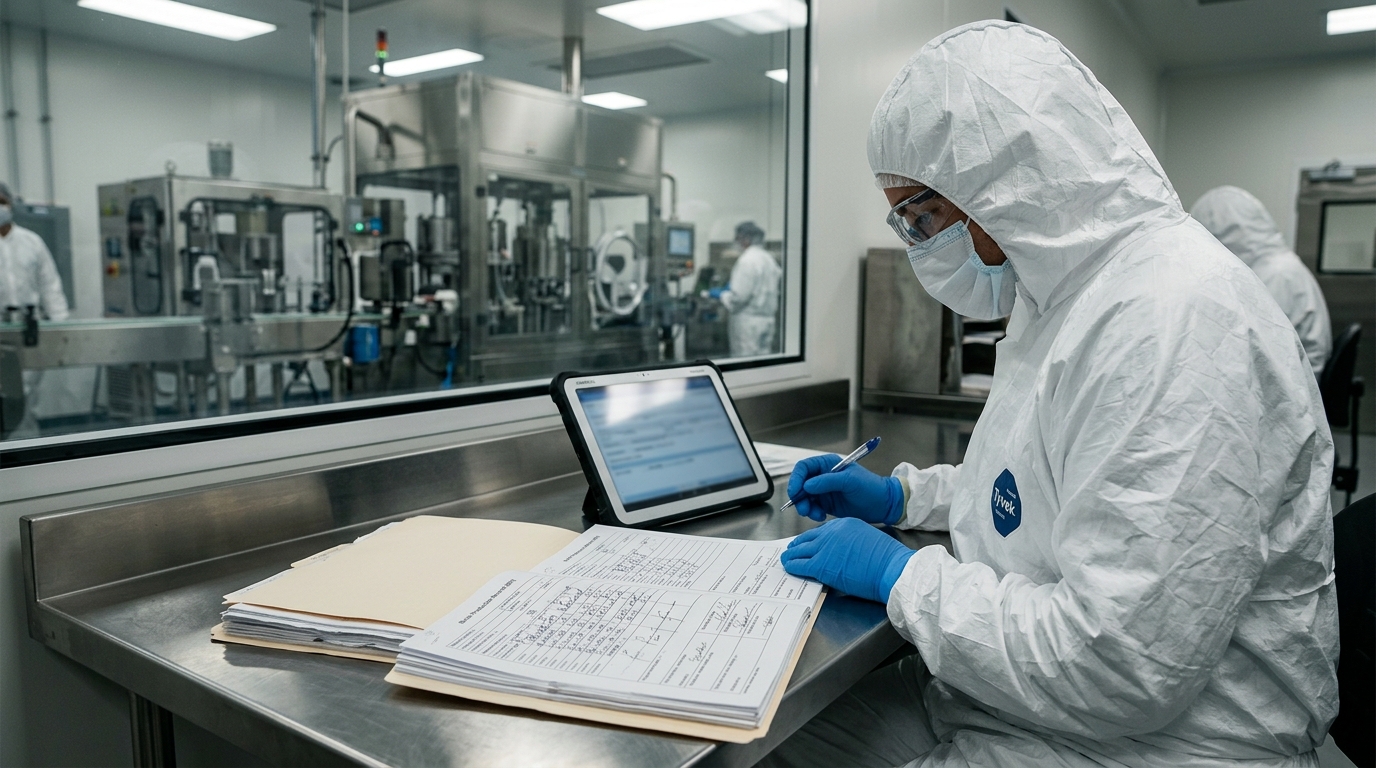
Why do highly regulated aseptic manufacturing sites still lose significant operational momentum to retrospective paperwork loops?
Operations leaders navigate a highly constrained environment where ensuring reliable patient supply is paramount. Yet, our diagnostic work in early 2026 across sterile facilities in the UK and Ireland revealed a costly, recurring pattern: teams spending 12 to 18 hours per week reviewing single batch records. During our engagement at a mid-sized commercial biologics fill-finish facility, this friction manifested as a 9-day average release hold waiting solely on missing in-process signatures. At a neighbouring clinical manufacturing site, teams logged 14 hours per week purely on administrative rework comments. These delays are driven by a fundamental misunderstanding: treating compliance as a retrospective QA policing exercise rather than an operational discipline.
WHERE PERFORMANCE IS LOST
The fundamental misstep most organisations make is treating batch record delays as a resource capacity problem to be solved by adding QA headcount—an expensive economic trade-off that yields diminishing returns. In reality, the loss is driven by three distinct structural barriers:
- The Regulatory Lock-in Myth: Site leadership frequently misinterprets regulatory guidelines, believing that compliance requires QA to remain entirely hands-off until a batch is fully completed. This self-imposed barrier prevents active, concurrent review and forces a massive, back-ended administrative burden.
- The Documentation Training Gap: Operators are trained to view the physical manipulation of the aseptic environment as "the real work," while documentation is treated as a secondary administrative chore. This cultural separation means data entry is rushed or deferred.
- The Signature Cascade Loop: Consider a concrete mechanism: a single missing operator signature on a critical environmental monitoring log during a filling run. Because the error is only caught during the end-of-batch review days later, it triggers a formal deviation. The resulting investigation requires retrieving shift logs, interviewing operators who no longer recall the specific shift, and routing a justification through three levels of QA approval. A five-second omission at the line cascades into a 3-day multi-departmental investigation loop.
In our analysis of 28 sampled aseptic batch records at a UK sterile facility, 54% of all documented review comments stemmed from this exact type of preventable administrative cascade, locking highly paid QA specialists into low-value clerical chasing.
THE PATH FORWARD

To unlock latent capacity and stabilise release cycles, site heads must dismantle the regulatory myths and realign operational ownership. In a recent pilot across three critical sterile filling lines, transitioning to concurrent verification and clarifying regulatory expectations reduced average review time from 16 hours per week to just 7.5 hours in only five weeks.
We recommend three immediate interventions:
1. De-risk concurrent review with QA: Re-interpret regulatory guidelines to allow QA and shift leads to perform real-time verification at the end of each unit operation, rather than waiting for final batch closure.
2. Integrate documentation into standard work: Redesign operator training so that completing a record is treated as a critical process parameter (CPP) equivalent to sterile interventions, preventing the signature cascade before it starts.
3. Optimise QA resource allocation: Shift QA personnel from retrospective administrative chasing to active, floor-based operational coaching during runs, maximising the economic value of your technical headcount.
Continuing to tolerate these paperwork loops is a choice to misallocate scarce technical resources.
As a site leader, are you content to let defensive regulatory interpretations and a cultural training gap lock your highest-paid QA assets into the role of administrative clerks? Or is it time to treat documentation as a core operational discipline?